
Living with chronic pain can make everyday activities such as walking, working, exercising, sleeping or even sitting uncomfortable. When medicines, physical therapy and lifestyle changes do not provide enough relief, your doctor may consider an injection-based pain treatment.
One approach used in modern pain management is an ultrasound-guided pain injection.
Unlike a traditional injection that may rely mainly on anatomical landmarks and the doctor’s knowledge of the underlying anatomy, ultrasound guidance allows the doctor to see relevant structures in real time while positioning the needle.
This can help the clinician identify the target area and guide the needle toward the intended location. Research suggests that ultrasound guidance improves injection accuracy for many musculoskeletal procedures, although the effect on pain relief and function can vary depending on the condition and injection site.
At Good Life Pain Clinic, Vadodara, image-guided interventional pain procedures are part of the clinic’s approach to selected chronic pain conditions. The clinic states that procedures can be performed using ultrasound or X-ray/C-arm guidance depending on the treatment and target area.
This guide explains what ultrasound-guided pain injections are, how they work, which conditions they may help, their benefits and risks, what recovery is like, and when you should consider consulting a pain specialist.
What Are Ultrasound-Guided Pain Injections?
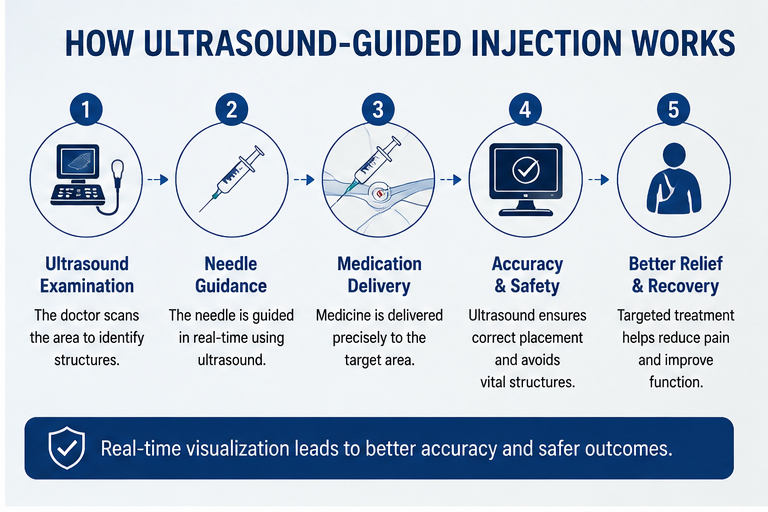
An ultrasound-guided pain injection is a minimally invasive procedure in which ultrasound imaging is used to help guide a needle toward a specific anatomical structure.

Ultrasound uses high-frequency sound waves to produce real-time images of tissues inside the body.
Depending on the condition, the target may be:
- A joint
- Bursa
- Tendon or surrounding tissue
- Muscle
- Peripheral nerve
- Ligament
- Other soft-tissue structures
The medication injected depends on the diagnosis and treatment objective.
Possible injectates include:
- Local anaesthetic
- Corticosteroid
- Platelet-rich plasma (PRP)
- Hyaluronic acid in selected joint conditions
- Other medications or substances when clinically appropriate
The choice of injection should be based on the patient’s diagnosis, medical history and treatment goals.
Good Life Pain Clinic states that its interventional procedures use image guidance to help diagnose pain sources and deliver medication to pathological sites. The clinic lists ultrasound-guided procedures involving areas such as the knee, shoulder, elbow, wrist, hip, ankle and selected spine-related procedures.
How Does Ultrasound Guidance Work?
Ultrasound guidance provides the doctor with a live view of the treatment area.
During the procedure, the ultrasound probe is placed against the skin near the area being treated.
The doctor can identify relevant structures such as:
- Tendons
- Muscles
- Joints
- Bursae
- Nerves
- Blood vessels
- Other soft tissues
The needle can then be advanced toward the intended target while its position is monitored using ultrasound.
This is particularly useful when the target is close to important nerves or blood vessels or when precise placement is important.
A review of systematic reviews and meta-analyses found that ultrasound-guided injections were generally more accurate than landmark-guided injections across several musculoskeletal sites, although improvements in pain and function were not uniform across every condition.
Ultrasound-Guided vs Traditional “Blind” Injection
A traditional injection may be performed using anatomical landmarks. The clinician identifies the target based on the patient’s anatomy, physical examination and surface landmarks.
This can work well in some situations, but the exact location of deeper structures may vary between individuals.
Ultrasound guidance adds real-time visualization.
Landmark-guided injection
The doctor uses:
- Anatomical landmarks
- Physical examination
- Knowledge of anatomy
Ultrasound-guided injection
The doctor can additionally use:
- Real-time ultrasound imaging
- Visualization of soft tissues
- Visualization of the needle
- Visualization of relevant surrounding structures
Research has found that ultrasound can improve accuracy in several joint and soft-tissue injections. For example, evidence in knee procedures indicates higher accuracy with ultrasound guidance compared with palpation-guided techniques.
However, this does not mean every ultrasound-guided injection will automatically produce better pain relief than a non-guided injection.
The effectiveness still depends on the diagnosis, medication used, injection target and expertise of the treating clinician.
What Conditions Can Be Treated With Ultrasound-Guided Injections?
Ultrasound-guided injections are used for selected musculoskeletal and nerve-related pain conditions.
They may be considered for conditions involving the:
- Knee
- Shoulder
- Hip
- Elbow
- Wrist
- Ankle
- Muscles
- Tendons
- Bursae
- Peripheral nerves
Good Life Pain Clinic describes ultrasound-guided procedures for several of these areas.
Let’s look at some common applications.
1. Ultrasound-Guided Knee Injections
Knee pain can occur because of osteoarthritis, inflammation, injury, bursitis, tendon problems and other conditions.
Ultrasound can help identify the knee joint and surrounding structures and guide the needle toward the intended location.
Depending on the diagnosis, possible injections may include:
- Corticosteroid
- Local anaesthetic
- Hyaluronic acid
- PRP
Good Life Pain Clinic specifically describes ultrasound-guided knee joint and bursa injections and lists local anaesthetics, steroids, hyaluronic acid and PRP among possible injectates depending on the pathology.
A systematic review and meta-analysis of randomized trials in knee osteoarthritis found that ultrasound-guided intra-articular injections improved procedural pain and some patient-reported outcomes compared with landmark-guided injections.
2. Ultrasound-Guided Shoulder Injections
Shoulder pain may be associated with conditions such as:
- Rotator cuff disorders
- Bursitis
- Frozen shoulder
- Tendon problems
- Joint inflammation
Ultrasound can help visualize the shoulder structures and guide the needle toward the intended target.
The evidence is mixed regarding whether ultrasound guidance always produces better long-term pain outcomes than landmark-guided shoulder injections. A Cochrane review found that, for shoulder pain, ultrasound guidance may not provide a clinically important improvement in pain or function compared with non-image-guided injection in all circumstances.
This illustrates an important point:
Better needle accuracy does not always guarantee better long-term pain relief.
The underlying diagnosis and treatment selection remain critical.
3. Ultrasound-Guided Hip Injections
Hip and surrounding soft-tissue pain can be associated with:
- Osteoarthritis
- Bursitis
- Tendinopathy
- Greater trochanteric pain syndrome
- Iliopsoas-related pain
- Other soft-tissue conditions
Ultrasound can help visualize the hip region and guide injections around the joint, bursae, tendons or other structures.
Evidence suggests ultrasound may improve the accuracy and safety of several hip-related musculoskeletal interventions compared with landmark-guided approaches.
4. Ultrasound-Guided Nerve Blocks
Some chronic pain conditions involve peripheral nerves.
An ultrasound-guided nerve block can allow the doctor to identify the nerve and surrounding structures before placing the needle.
Depending on the condition, a nerve block may serve:
- A diagnostic purpose
- A therapeutic purpose
- Both
For example, Good Life Pain Clinic describes ultrasound-guided saphenous nerve blocks for selected knee and leg pain and ultrasound-guided injections around the piriformis and obturator internus muscles in selected patients with buttock or sciatic-type pain.
5. Ultrasound-Guided Trigger Point Injections
Trigger points are painful areas within tight bands of muscle.
They can develop in areas such as:
- Neck
- Upper back
- Lower back
- Shoulder region
Potential contributing factors include:
- Repetitive strain
- Poor posture
- Muscle overload
- Injury
- Prolonged static positions
Good Life Pain Clinic states that it prefers ultrasound guidance for trigger-point injections because it can help improve accuracy and reduce the chance of complications. The clinic also emphasizes physiotherapy after the injection to support the longer-term treatment plan.
6. Ultrasound-Guided Tendon and Bursa Injections
Tendons and bursae can become painful because of overuse, inflammation or injury.
Examples include:
- Proximal hamstring tendinopathy
- Greater trochanteric pain syndrome
- Bursitis
- Selected tendon-related disorders
Ultrasound allows the clinician to visualize the tendon or bursa and place the injection accurately.
Good Life Pain Clinic describes ultrasound-guided peritendinous injections for selected proximal hamstring problems and ultrasound-guided injections for greater trochanteric pain syndrome.
The injection should be directed to the appropriate tissue rather than automatically injected into the tendon itself.
What Medications Are Used in Ultrasound-Guided Pain Injections?
The medication depends on the underlying condition.
Local Anaesthetic
Local anaesthetics temporarily reduce nerve sensation.
They may be used:
- To reduce procedural discomfort
- As part of a diagnostic nerve block
- As part of a therapeutic injection
Corticosteroids
Steroids can reduce inflammation in selected conditions.
They may be used for certain:
- Joint conditions
- Bursa inflammation
- Nerve-related pain
- Tendon-associated inflammatory conditions
Steroids are not appropriate for every pain condition and repeated injections need careful consideration.
Platelet-Rich Plasma (PRP)
PRP is produced from the patient’s own blood.
A blood sample is processed to concentrate platelets, which contain growth-related proteins.
PRP is used in selected musculoskeletal conditions, although evidence varies considerably depending on the condition and treatment protocol.
Good Life Pain Clinic describes PRP injections under ultrasound guidance for selected knee and tendon-related conditions.
Hyaluronic Acid
Hyaluronic acid injections may be considered in selected patients with osteoarthritis, particularly involving joints such as the knee.
The suitability and expected benefit depend on the patient’s condition.
What Are the Benefits of Ultrasound-Guided Pain Injections?
There are several potential advantages.
1. Real-Time Visualization
The doctor can see the target structures during the procedure rather than relying only on surface landmarks.
2. Improved Accuracy
Evidence generally shows that ultrasound-guided injections are more accurate for many musculoskeletal targets.
3. Visualization of Blood Vessels and Nerves
Ultrasound can help identify important structures near the treatment area.
This can be particularly useful when the target is close to a nerve or blood vessel.
4. No Ionizing Radiation
Unlike X-ray or fluoroscopy, diagnostic ultrasound does not use ionizing radiation.
This can be an important advantage in appropriate procedures.
5. Potentially Less Procedural Discomfort
In some procedures, improved targeting may reduce unnecessary needle movement.
Evidence in knee osteoarthritis injections has shown lower procedural pain with ultrasound guidance compared with landmark-guided injections.
6. Outpatient Treatment
Many ultrasound-guided injections can be performed as outpatient or day-care procedures.
Good Life Pain Clinic states that its interventional pain procedures generally take approximately 30–60 minutes and are usually performed as day-care procedures.
7. Can Support Non-Surgical Treatment
For appropriately selected patients, injections may be incorporated into a broader treatment plan involving physiotherapy, exercise and lifestyle changes.
They should not automatically be considered a replacement for surgery when surgery is medically necessary.
Are Ultrasound-Guided Injections Safe?
When appropriately indicated and performed by a trained clinician, ultrasound-guided injections are generally considered safe.
However, no invasive procedure is completely risk-free.
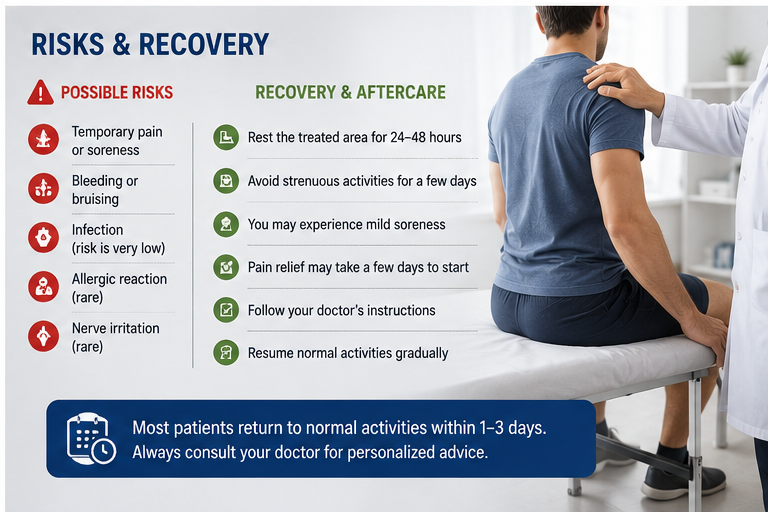
Potential complications include:
- Temporary pain
- Bruising
- Bleeding
- Infection
- Allergic reaction
- Temporary numbness
- Nerve irritation
- Injury to surrounding structures
- Medication-specific side effects
The exact risk depends on:
- Injection location
- Medication used
- Patient’s medical history
- Existing medications
- Clinician experience
- Sterility and procedural technique
Evidence comparing ultrasound-guided and landmark-guided musculoskeletal injections generally reports low rates of adverse events, with serious complications being uncommon.
What Are the Risks of Steroid Injections?
If a corticosteroid is used, there may be additional medication-specific risks.
Depending on the dose, frequency and injection location, potential effects can include:
- Temporary increase in blood glucose
- Skin or soft-tissue changes
- Temporary flushing
- Infection
- Local tissue effects
- Rare systemic effects
Patients with diabetes, blood-thinning medication use, immune-system problems or other significant medical conditions should inform their doctor before the procedure.
The number and frequency of steroid injections should also be determined by the treating clinician.
What Are the Risks of PRP Injections?
PRP uses the patient’s own blood, so allergic reactions to the injected platelet preparation itself are generally less of a concern than with some other substances.
However, the procedure can still cause:
- Temporary pain
- Swelling
- Bruising
- Infection
- Bleeding
PRP is also not a guaranteed treatment.
Evidence for PRP differs substantially between conditions, and patients should discuss realistic expectations with their doctor.
What Happens During an Ultrasound-Guided Pain Injection?
Although the exact procedure varies, the general process may involve the following steps.
Step 1: Medical Assessment
The doctor reviews:
- Symptoms
- Medical history
- Previous treatments
- Imaging
- Physical examination
- Current medications
The goal is to determine whether the injection is appropriate.
Step 2: Positioning
You are positioned so the doctor can safely access the treatment area.
Step 3: Ultrasound Examination
The ultrasound probe is placed over the relevant area.
The doctor identifies the target structure and surrounding anatomy.
Step 4: Skin Cleaning
The skin is cleaned using appropriate antiseptic preparation.
Step 5: Local Anaesthesia
Depending on the procedure, local anaesthetic may be used to reduce discomfort.
Step 6: Needle Placement
The needle is advanced toward the target while the clinician uses ultrasound to guide its position.
Step 7: Medication Delivery
The selected medication is delivered at the intended site.
Step 8: Needle Removal
The needle is removed and the area is cleaned and covered.
Step 9: Observation
You may be monitored briefly before being discharged.
Good Life Pain Clinic states that its interventional procedures are performed in an operating-theatre setting with monitoring and generally require 2–4 hours of post-procedure observation, although many procedures are day-care interventions.
Is an Ultrasound-Guided Injection Painful?
Most patients tolerate these procedures reasonably well.
You may feel:
- A brief needle prick
- Pressure
- Mild discomfort
- Temporary burning from local anaesthetic
- Pressure during medication injection
The level of discomfort depends on:
- Injection location
- Needle size
- Tissue involved
- Individual pain sensitivity
- Type of procedure
Good Life Pain Clinic states that its interventional procedures are generally minimally painful and usually performed under local anaesthesia rather than general anaesthesia or sedation.
How Long Does an Ultrasound-Guided Injection Take?
The exact time varies by procedure.
A simple injection may take only a short time, while a more complex intervention may take longer.
Good Life Pain Clinic states that its interventional pain procedures generally take approximately 30–60 minutes, followed by observation.
The total time at the clinic may therefore be longer than the injection itself.
Ultrasound-Guided Injection Recovery
Recovery depends primarily on:
- The body part treated
- Medication injected
- Underlying condition
- Type of procedure
- Individual response
Many patients can return home the same day.
However, your doctor may recommend temporary activity restrictions.
Immediately After the Injection
You may experience:
- Mild soreness
- Tenderness
- Temporary numbness
- Bruising
- Temporary improvement from local anaesthetic
If a local anaesthetic is used, pain may initially improve and then return once its effect wears off. This does not necessarily mean the treatment has failed.
If a steroid is used, the anti-inflammatory effect may take several days to become noticeable.
Good Life Pain Clinic notes that some injections may take a few days and sometimes weeks for their full effects to become apparent.
What Should You Do After an Ultrasound-Guided Injection?
Your exact instructions depend on the procedure.
Common recommendations may include:
- Rest the treated area initially
- Avoid strenuous exercise for the recommended period
- Follow medication instructions
- Keep the injection site clean
- Gradually return to normal activities
- Begin or continue physiotherapy when advised
- Monitor your symptoms
For many chronic pain conditions, the injection is not the entire treatment.
The longer-term goal is often to use the period of reduced pain to improve movement, strength and function.
Good Life Pain Clinic specifically states that rehabilitation involving home exercises and lifestyle modifications is advised following interventional procedures.
When Does Pain Relief Start?
There is no single timeline.
It depends on the medication and condition.
Local Anaesthetic
Relief can begin relatively quickly but is usually temporary.
Steroid
The anti-inflammatory effect may take several days or longer.
PRP
The response may develop more gradually and can vary considerably between patients.
Diagnostic Blocks
The goal may be to determine whether a specific structure contributes to the patient’s pain rather than to provide long-term relief.
Your doctor should explain the expected response before the procedure.
How Long Does Pain Relief Last?
The duration of relief depends on:
- Underlying condition
- Medication used
- Severity of disease
- Treatment target
- Rehabilitation
- Individual response
Some injections may provide short-term relief, while others may help for a longer period.
Importantly, an injection does not necessarily correct the underlying structural problem.
For example, if a patient has muscle weakness, poor movement mechanics or ongoing overload, pain may return unless these factors are also addressed.
Is Ultrasound-Guided Injection Better Than X-Ray-Guided Injection?
Not necessarily.
The appropriate imaging method depends on the procedure.
Ultrasound
Advantages include:
- Real-time soft-tissue visualization
- No ionizing radiation
- Visualization of vessels and nerves
- Useful for many superficial and musculoskeletal targets
X-ray/Fluoroscopy
Advantages include:
- Excellent visualization of bones
- Useful for many spinal procedures
- Can be combined with contrast to confirm needle position
Some procedures are better suited to one imaging method than another.
Good Life Pain Clinic uses both ultrasound and C-arm/X-ray guidance depending on the procedure and anatomical target.
The decision should be based on safety, accuracy and the specific clinical objective.
Can Ultrasound-Guided Injections Avoid Surgery?
In selected patients, injections may help manage pain and improve function without immediate surgery.
However, they should not be marketed as a guarantee that surgery will never be needed.
For some conditions, an injection may:
- Reduce pain
- Facilitate physiotherapy
- Improve mobility
- Provide diagnostic information
- Delay the need for more invasive treatment
But if a patient has a condition requiring surgery, an injection should not be used to indefinitely postpone necessary treatment.
The appropriate goal is the least invasive treatment that is safe and appropriate for the patient’s condition.
Who May Be a Candidate for an Ultrasound-Guided Injection?
You may be considered for an ultrasound-guided injection if:
- Your pain has a clearly suspected source
- Conservative treatment has not provided adequate relief
- The target can be safely visualized with ultrasound
- An injection is medically appropriate
- You understand the potential benefits and risks
A doctor may recommend other treatment instead if:
- The diagnosis is unclear
- The injection is unlikely to help
- There is an untreated infection
- Another treatment is more appropriate
- The target cannot be safely accessed
Who Should Avoid or Delay an Injection?
The decision depends on the individual.
You should inform your doctor if you:
- Have an active infection
- Take blood-thinning medication
- Have a bleeding disorder
- Have poorly controlled diabetes
- Have significant immune-system problems
- Have medication allergies
- Are pregnant or may be pregnant
- Have previously reacted badly to injections
Never stop blood thinners or other prescribed medicines without medical advice.
When Should You Seek Medical Help After an Injection?
Most injections have no serious complications, but certain symptoms require medical attention.
Contact your healthcare provider if you develop:
- Increasing redness
- Significant swelling
- Fever
- Severe or worsening pain
- Pus or drainage
- Persistent or worsening numbness
- New weakness
- Difficulty moving the treated limb
- Other unexpected symptoms
Seek urgent medical care for severe neurological symptoms, breathing difficulty, severe allergic symptoms or other potentially serious reactions.
Ultrasound-Guided Pain Injections vs Physiotherapy
These treatments are not necessarily competitors.
In many cases, they can work together.
An injection may reduce pain sufficiently to allow a patient to participate more effectively in physiotherapy.
Physiotherapy can then address:
- Muscle weakness
- Poor movement patterns
- Flexibility
- Posture
- Functional limitations
- Conditioning
This combination can be particularly useful when pain has prevented the patient from exercising.
Good Life Pain Clinic emphasizes rehabilitation and lifestyle modification following interventional procedures.
How to Prepare for an Ultrasound-Guided Pain Injection
Before your appointment:
Tell Your Doctor About Your Medicines
Especially:
- Blood thinners
- Diabetes medication
- Steroids
- Pain medicines
- Supplements
Tell Your Doctor About Medical Conditions
Including:
- Diabetes
- Bleeding disorders
- Allergies
- Previous infections
- Previous reactions to injections
Bring Relevant Reports
If you have:
- MRI
- X-ray
- Ultrasound
- Blood test reports
- Previous treatment records
bring them to the consultation if requested.
Follow Fasting Instructions
Many ultrasound-guided injections under local anaesthesia may not require prolonged fasting, but instructions vary depending on the procedure.
Always follow the clinic’s specific instructions.
Cost of Ultrasound-Guided Pain Injections in India
The cost can vary significantly.
There is no single price for an “ultrasound-guided pain injection” because the term covers many different procedures.
The total cost may depend on:
- Body part treated
- Type of injection
- Medication used
- PRP preparation, if applicable
- Doctor’s professional fee
- Ultrasound/procedure-room charges
- Number of injections
- Follow-up requirements
- Additional diagnostic investigations
For this reason, it is better to obtain a procedure-specific estimate after consultation rather than relying on a generic online price.
At Good Life Pain Clinic, the appropriate intervention is selected after clinical assessment, and the clinic can provide information about the recommended procedure and associated costs.
Why Choose Good Life Pain Clinic for Ultrasound-Guided Pain Injections?
Good Life Pain Clinic, Vadodara, focuses on pain and palliative care and provides individualized treatment plans based on medical history, clinical examination and appropriate investigations.
The clinic’s interventional pain services include procedures performed under ultrasound or C-arm/X-ray guidance, depending on the condition and anatomical target.
The clinic describes ultrasound-guided procedures for selected:
- Knee conditions
- Shoulder conditions
- Hip conditions
- Elbow and wrist problems
- Ankle problems
- Muscle and tendon conditions
- Peripheral nerve-related pain
It also describes ultrasound-guided trigger-point injections and selected nerve blocks.
Dr. Akanksha Bansal is listed by the clinic as an MD, FIAPM Gold Medallist and European Diploma in Pain Medicine holder, specializing in pain and palliative care.
The aim should not simply be to perform an injection.
The goal is to identify the likely source of pain, choose an appropriate treatment, reduce pain where possible and support rehabilitation and improved function.
Frequently Asked Questions About Ultrasound-Guided Pain Injections
1. What is an ultrasound-guided pain injection?
It is an injection performed while using ultrasound imaging to visualize the treatment area and guide the needle toward the intended anatomical target.
2. Are ultrasound-guided injections safe?
They are generally considered safe when appropriately indicated and performed by trained professionals, but all injections carry potential risks such as infection, bleeding, temporary pain and medication-specific side effects.
3. Are ultrasound-guided injections painful?
Most patients experience only brief discomfort or pressure. Local anaesthesia may be used depending on the procedure.
4. How long does an ultrasound-guided injection take?
The duration varies by procedure. Good Life Pain Clinic states that its interventional procedures generally take approximately 30–60 minutes.
5. How long does it take to recover?
Many procedures are performed as day-care treatments, but recovery depends on the injection and body part treated.
6. How quickly does the injection work?
Local anaesthetic can work quickly, while steroid effects may take several days or longer. PRP responses may develop more gradually.
7. How long does pain relief last?
It varies by diagnosis, medication, treatment target and individual response. Some injections provide temporary relief, while others may provide longer-lasting improvement.
8. Can ultrasound-guided injections treat knee pain?
Yes. Ultrasound can guide selected knee joint, bursa and nerve-related injections. Good Life Pain Clinic specifically lists ultrasound-guided knee joint and bursa injections.
9. Can ultrasound-guided injections treat shoulder pain?
Yes. They can be used for selected shoulder conditions such as bursitis and some tendon or joint-related problems.
10. Can ultrasound-guided injections treat sciatica?
Some pain procedures for sciatica use image guidance, but spinal injections are often performed under X-ray/fluoroscopy depending on the target. Good Life Pain Clinic describes both X-ray-guided spinal procedures and ultrasound-guided procedures for selected related muscle and nerve conditions.
11. Can ultrasound guidance eliminate injection risks?
No. Ultrasound can help visualize anatomy and guide needle placement, but it cannot eliminate all complications.
12. Is ultrasound better than X-ray guidance?
Neither is universally better. The appropriate imaging method depends on the body part, procedure and clinical objective.
13. Can an injection replace surgery?
Sometimes an injection can help a patient avoid or delay surgery, but it cannot replace surgery when surgery is medically necessary.
14. Can I return home after the injection?
Many ultrasound-guided pain injections are outpatient procedures, but your doctor will determine when it is safe for you to leave.
15. Will I need physiotherapy after the injection?
Not everyone needs the same rehabilitation program, but physiotherapy and exercise are often important components of long-term pain management.
Final Takeaway
Ultrasound-guided pain injections combine medication-based treatment with real-time imaging to help accurately target specific painful structures.
For appropriately selected patients, they may be useful for conditions affecting the joints, muscles, tendons, bursae and peripheral nerves.
Potential advantages include:
- Improved visualization
- Greater injection accuracy for many targets
- No ionizing radiation
- Ability to visualize nearby soft tissues
- Minimally invasive treatment
- Day-care treatment for many procedures
However, ultrasound guidance is not a guarantee of better pain relief, and injections are not appropriate for every patient. Evidence shows that accuracy improvements do not always translate into superior long-term pain or functional outcomes across every body part.
The most important step is therefore to determine the actual source of pain and select the treatment that fits your condition.
If chronic knee, shoulder, hip, muscle, tendon, nerve or other pain is affecting your daily life despite conservative treatment, an assessment by a pain specialist can help determine whether an ultrasound-guided injection or another treatment may be appropriate.
Book a Pain Consultation in Vadodara
At Good Life Pain Clinic, treatment is individualized based on your symptoms, clinical examination and appropriate investigations.
If an image-guided procedure is appropriate, the clinic uses ultrasound or C-arm/X-ray guidance depending on the treatment and target.
Good Life Pain Clinic
First Floor, Trinity Complex, Opp. Caffeine Restaurant, Vasna Jakkat Nakka, Vasna Road, Vadodara, Gujarat – 390015
Phone: +91-9484540774
Email: goodlifepainclinic@gmail.com