
Sciatica can make ordinary activities such as walking, sitting, sleeping, driving and working extremely uncomfortable. The pain may begin in the lower back or buttock and travel down the leg, sometimes accompanied by tingling, numbness or weakness.
Because sciatica can be intense, many patients immediately worry that they will need spine surgery.
The good news is that surgery is not required for every person with sciatica. Many patients improve with appropriate non-surgical treatment, particularly when there is no progressive neurological weakness or other serious warning sign.
Modern pain medicine provides several treatment options that can be considered depending on the cause and severity of the symptoms. These may include medication, physiotherapy, activity modification, targeted exercises, image-guided injections and selected interventional pain procedures.
At Good Life Pain Clinic in Vadodara, sciatica is one of the conditions managed through an individualized pain-management approach. The clinic describes both conservative and minimally invasive interventional options for selected patients.
This guide explains sciatica treatment without surgery, the latest medical options, when injections may help, the role of physiotherapy, recovery expectations, warning signs and when surgery may become necessary.
What Is Sciatica?
Sciatica refers to pain or other symptoms caused by irritation or compression of the sciatic nerve or its nerve roots.
The sciatic nerve is one of the largest nerves in the body. It is formed by nerve roots originating in the lower spine and travels through the buttock and down the leg.
Sciatica typically affects one side of the body.
Symptoms may include:
- Sharp or burning pain
- Pain travelling from the lower back into the buttock and leg
- Tingling
- Numbness
- Muscle weakness
- Electric-shock-like sensations
- Pain that worsens with certain movements
The term “sciatica” describes a pattern of symptoms rather than one specific disease.
The underlying cause needs to be identified before choosing treatment.
What Causes Sciatica?
Several conditions can irritate or compress the nerves responsible for sciatic symptoms.
Common causes include:
Herniated Disc
A herniated or slipped disc can press against a spinal nerve root.
Spinal Stenosis
Narrowing of spaces in the spine can place pressure on nerves.
Degenerative Disc Changes
Age-related changes in the spinal discs can contribute to nerve irritation in some patients.
Spondylolisthesis
One vertebra can shift relative to another and potentially narrow the space available for nerves.
Piriformis and Deep Gluteal Conditions
In selected cases, structures outside the spine can irritate the sciatic nerve.
Because different conditions can produce similar symptoms, proper evaluation is important.
Can Sciatica Be Treated Without Surgery?
Yes, many cases of sciatica can be treated without surgery.
For patients without serious neurological deficits, treatment often begins with conservative measures.
These may include:
- Staying appropriately active
- Pain medication when appropriate
- Physiotherapy
- Targeted exercise
- Activity modification
- Lifestyle changes
- Image-guided injections for selected patients
- Interventional pain-management procedures
The exact treatment depends on the cause of the sciatica.
For example, treatment for mild nerve irritation may be very different from treatment for severe nerve compression caused by a disc herniation.
Latest Non-Surgical Sciatica Treatment Options
Modern sciatica management is not based on one treatment.
Instead, doctors may combine several approaches according to the patient’s symptoms and diagnosis.
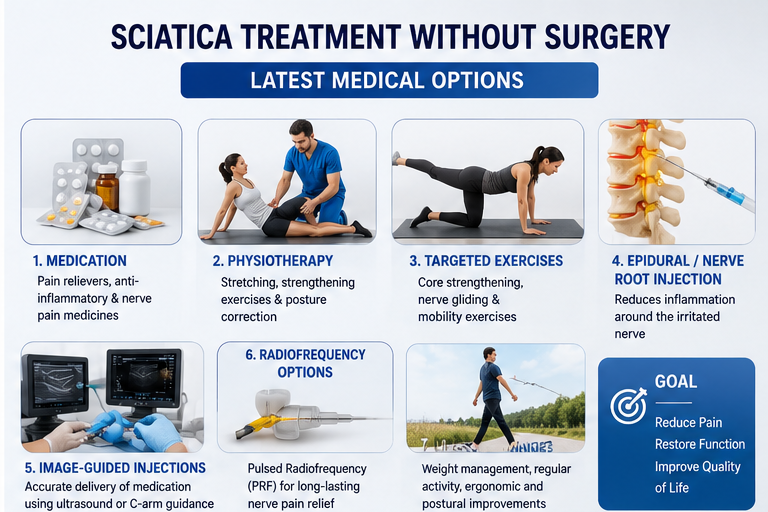
The major options include:
- Conservative care
- Physiotherapy
- Targeted exercise
- Medication
- Epidural or selective nerve-root injections
- Image-guided pain procedures
- Radiofrequency-based procedures in selected conditions
- Lifestyle and ergonomic changes
- Multidisciplinary pain management
Let’s look at each option.
1. Staying Active Instead of Prolonged Bed Rest
One of the biggest changes in modern back-pain management is the recognition that prolonged bed rest is generally not helpful for most patients.
When pain is severe, short periods of rest may be necessary.
However, remaining inactive for prolonged periods can contribute to:
- Muscle weakness
- Stiffness
- Reduced physical conditioning
- Fear of movement
- Slower return to normal activity
The goal is usually relative rest followed by gradual movement.
This can involve:
- Short walks
- Changing positions regularly
- Avoiding prolonged sitting
- Gradually increasing activity
- Avoiding movements that significantly aggravate symptoms
Your doctor or physiotherapist can provide individualized activity recommendations.
2. Physiotherapy for Sciatica
Physiotherapy is one of the most important components of non-surgical sciatica treatment.
A physiotherapist can assess:
- Spinal movement
- Hip mobility
- Muscle strength
- Posture
- Walking pattern
- Functional limitations
- Response to specific movements
Treatment may include:
- Mobility exercises
- Core strengthening
- Hip strengthening
- Flexibility work
- Movement retraining
- Postural education
- Gradual functional rehabilitation
The goal is not simply to reduce pain temporarily.
A good rehabilitation program aims to restore movement, strength, confidence and function.
3. Targeted Exercises for Sciatica
There is no single “best exercise for sciatica.”
The appropriate exercise depends on the cause of your symptoms.
Some patients may benefit from:
- Gentle walking
- Core stabilization
- Hip strengthening
- Hamstring flexibility work
- Neural mobility exercises
- Directional-preference exercises
- Gradual resistance training
However, exercises should be selected carefully.
An exercise that improves one person’s symptoms may aggravate another person’s nerve pain.
Stop and Seek Advice If:
An exercise causes:
- Increasing leg pain
- New numbness
- New weakness
- Significant worsening of symptoms
Do not force your body through severe nerve pain simply because an exercise is labelled a “sciatica exercise.”
4. Medicines for Sciatica
Medication may be used to manage pain while the underlying condition improves.
Depending on the patient, a doctor may consider:
- Anti-inflammatory medication
- Pain relievers
- Medicines for neuropathic pain
- Muscle relaxants in selected situations
Medication choice depends on:
- Age
- Medical history
- Kidney and liver function
- Other medicines
- Cardiovascular risk
- Gastrointestinal risk
- Type of pain
Some medicines that are commonly used for general back pain are not necessarily effective for every patient with nerve-related pain.
Therefore, medication should be individualized rather than self-prescribed.
5. Epidural Steroid Injections
For selected patients with significant radicular pain, an epidural steroid injection may be considered.
The goal is to deliver medication near the irritated spinal nerve.
The injection may contain:
- Local anaesthetic
- Corticosteroid
The steroid is intended to reduce inflammation around the affected nerve.
Epidural injections are not appropriate for everyone, and they do not correct the underlying structural problem.
However, they may provide temporary relief in appropriately selected patients and potentially help the patient participate more effectively in rehabilitation.
6. Selective Nerve Root Blocks
A selective nerve root block targets a specific spinal nerve root.
This may have both:
- Diagnostic value
- Therapeutic value
If a particular nerve root is suspected to be causing symptoms, the procedure can help determine whether that nerve is contributing to the pain.
The procedure is usually performed using imaging guidance.
Good Life Pain Clinic describes image-guided spinal and nerve-related interventions for selected patients with back pain and sciatica. (goodlifepainclinic.com)
7. Image-Guided Injections
Modern interventional pain management often uses imaging to improve needle placement.
Depending on the procedure, guidance may involve:
- Ultrasound
- X-ray/fluoroscopy
- C-arm imaging
For spinal injections, fluoroscopic/X-ray guidance is commonly used because it allows visualization of spinal anatomy and needle placement.
For selected muscle, nerve and soft-tissue conditions associated with sciatic-type pain, ultrasound can also be useful.
Good Life Pain Clinic states that it uses ultrasound and C-arm guidance for selected interventional procedures. (goodlifepainclinic.com)
8. Ultrasound-Guided Treatment for Selected Sciatic-Type Pain
Not every case of sciatica originates from the spine.
Some patients have pain related to structures around the buttock or hip.
Examples may include:
- Piriformis-related pain
- Deep gluteal syndrome
- Muscle trigger points
- Peripheral nerve irritation
In selected cases, ultrasound can help visualize the relevant structures and guide an injection.
Good Life Pain Clinic describes ultrasound-guided injections around the piriformis and obturator internus muscles for selected patients with sciatic-type symptoms. (goodlifepainclinic.com)
This is why determining the actual source of symptoms is so important.
9. Pulsed Radiofrequency for Selected Nerve Pain
Radiofrequency-based techniques may be considered for selected nerve-related pain conditions.
Pulsed Radiofrequency (PRF) delivers radiofrequency energy differently from conventional thermal radiofrequency ablation.
Good Life Pain Clinic describes lumbar dorsal root ganglion pulsed radiofrequency as an intervention that may be considered in selected patients with radicular pain after appropriate assessment. (goodlifepainclinic.com)
PRF is not appropriate for every patient with sciatica, and it should not be presented as a universal replacement for surgery.
The decision depends on:
- Cause of pain
- Duration of symptoms
- Previous treatment response
- Neurological findings
- Imaging
- Overall health
10. Radiofrequency Ablation and Sciatica
It is important to distinguish sciatica caused by nerve-root compression from other types of lower-back pain.
Conventional medial branch radiofrequency ablation is generally aimed at pain arising from facet joints rather than direct nerve-root compression from a herniated disc.
Therefore, simply having “back pain plus leg pain” does not automatically mean RFA is appropriate.
A pain specialist should determine the actual pain generator before recommending a radiofrequency procedure.
This distinction is particularly important for patients searching online for “RFA for sciatica.”
11. Lifestyle Changes
Long-term management of sciatica may also involve lifestyle changes.
Helpful habits can include:
Maintaining a Healthy Weight
Excess body weight can increase mechanical stress on the spine.
Regular Physical Activity
Once acute symptoms improve, regular activity can help maintain strength and mobility.
Avoiding Smoking
Smoking can negatively affect spinal health and healing.
Improving Workstation Ergonomics
If you sit for long periods:
- Keep your screen at a comfortable height
- Support your lower back
- Avoid prolonged static sitting
- Take movement breaks
Safe Lifting
Use appropriate lifting technique and avoid lifting loads beyond your capacity.
How Long Does Sciatica Take to Improve Without Surgery?
Recovery varies significantly.
Some patients improve over several days or weeks, while others experience symptoms for longer.
Recovery depends on:
- Cause of sciatica
- Severity of nerve irritation
- Duration of symptoms
- Presence of weakness
- Overall health
- Treatment adherence
- Physical activity
- Response to treatment
A gradual reduction in pain and improvement in function are generally encouraging signs.
If symptoms are not improving or are becoming worse, the diagnosis and treatment plan may need to be reassessed.
Does Sciatica Go Away Permanently?
Sciatica can improve substantially or completely in many patients.
However, recurrence is possible.
Risk may be influenced by:
- Underlying spinal degeneration
- Disc problems
- Physical conditioning
- Lifestyle
- Work demands
- Previous episodes
- Body weight
- Smoking
After recovery, maintaining strength, mobility and healthy movement habits can be important for long-term spine health.
Is MRI Necessary for Sciatica?
Not every patient with sciatica requires an MRI immediately.
A clinician may first evaluate:
- Symptoms
- Neurological function
- Reflexes
- Muscle strength
- Sensation
- Walking ability
- Duration of symptoms
MRI may be considered when:
- Symptoms persist
- Symptoms are severe
- There is neurological weakness
- The diagnosis is uncertain
- An injection or surgery is being considered
- Serious causes need to be excluded
An MRI can identify:
- Disc herniation
- Nerve compression
- Spinal stenosis
- Degenerative changes
- Other structural abnormalities
However, an MRI finding does not automatically prove that it is causing the patient’s pain.
The scan should always be interpreted in the context of the patient’s symptoms and examination.
When Should You Consider an Injection for Sciatica?
An injection may be considered when:
- Pain remains significant despite conservative treatment
- Pain interferes with walking or sleep
- Leg pain limits physiotherapy
- The suspected pain source can be identified
- A targeted procedure may provide useful diagnostic information
- The patient is an appropriate candidate
An injection should be part of an overall treatment strategy rather than viewed as a standalone cure.
For example:
Injection → Pain reduction → Physiotherapy → Strengthening → Functional recovery
This approach may be more useful than repeatedly receiving injections without addressing the factors contributing to pain.
Benefits of Non-Surgical Sciatica Treatment
Non-surgical treatment can provide several potential advantages.
Avoids Surgical Risks
When surgery is not medically necessary, conservative treatment avoids surgical risks.
Can Be Personalized
Treatment can be adjusted according to the cause and severity of symptoms.
Supports Rehabilitation
Reducing pain may make it easier to participate in physiotherapy.
Minimally Invasive Options Are Available
Selected patients may benefit from image-guided injections or other interventional procedures.
May Provide Meaningful Pain Relief
Many patients experience improvement without surgery, although individual results vary.
Risks and Limitations of Non-Surgical Treatment
Non-surgical treatment is not risk-free or guaranteed to work.
Potential limitations include:
- Pain may persist
- Symptoms may recur
- Medicines may cause side effects
- Injections may provide temporary rather than permanent relief
- Some conditions may ultimately require surgery
- Delaying necessary treatment can be harmful in patients with serious neurological symptoms
This is why ongoing clinical assessment is important.
When Is Surgery Needed for Sciatica?
Most patients do not automatically need surgery.
However, surgery may become appropriate when:
- Severe symptoms persist despite appropriate non-surgical treatment
- There is significant or progressive muscle weakness
- Walking ability deteriorates
- A structural problem clearly matches the symptoms
- There is serious nerve compression
- Bladder or bowel function is affected
Surgery may be urgent when severe neurological symptoms occur.
Sciatica Red Flags: When Should You Seek Urgent Help?
Do not try to manage certain symptoms at home.
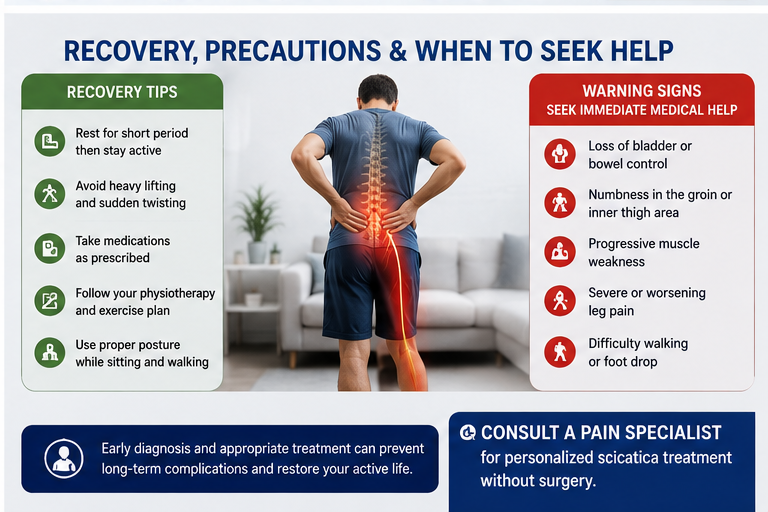
Seek urgent medical assessment if you develop:
- New loss of bladder control
- New loss of bowel control
- Difficulty urinating
- Numbness around the groin, genital or inner-thigh area
- Severe or rapidly progressing weakness
- Major difficulty walking
- Severe neurological deterioration
These symptoms can indicate serious nerve compression.
They may represent cauda equina syndrome, which requires urgent medical evaluation.
Can Sciatica Be Cured Without Surgery?
The word “cure” can be misleading.
For some patients, symptoms may resolve completely.
For others, treatment may reduce pain and restore function while the underlying spinal condition remains.
The goal of treatment should therefore be:
Less pain + better function + improved mobility + reduced disability + prevention of recurrence where possible.
Rather than searching for one miracle treatment, patients should focus on identifying the cause and following an evidence-based treatment plan.
Sciatica Treatment Without Surgery in Vadodara
Patients searching for sciatica treatment in Vadodara have several non-surgical treatment options to discuss with a qualified pain specialist.
At Good Life Pain Clinic, the approach described on the clinic’s website includes assessment followed by an individualized treatment plan.
The clinic lists treatment approaches for back pain and sciatica that can include:
- Medication
- Physiotherapy
- Nerve blocks
- Image-guided injections
- Ultrasound-guided procedures
- C-arm-guided procedures
- Selected pulsed radiofrequency procedures
The appropriate treatment depends on the individual diagnosis. (goodlifepainclinic.com)
Why Choose Good Life Pain Clinic for Sciatica Treatment?
Good Life Pain Clinic, Vadodara, specializes in pain and palliative care and manages conditions including back pain and sciatica. (goodlifepainclinic.com)
The clinic describes an approach based on:
History → Examination → Diagnosis → Individualized treatment → Rehabilitation
Its interventional procedures may be performed using ultrasound or C-arm/X-ray guidance depending on the target and procedure. (goodlifepainclinic.com)
Dr. Akanksha Bansal is listed as an MD, FIAPM Gold Medallist and European Diploma in Pain Medicine holder, specializing in pain and palliative care. (goodlifepainclinic.com)
For patients who want to explore non-surgical options before considering surgery, a detailed assessment can help determine whether conservative care, physiotherapy, injections or another intervention is appropriate.
Frequently Asked Questions About Sciatica Treatment Without Surgery
1. Can sciatica be treated without surgery?
Yes. Many patients improve with non-surgical treatments such as activity modification, medication, physiotherapy and selected image-guided injections.
2. What is the best treatment for sciatica without surgery?
There is no single best treatment for everyone. The best approach depends on the cause, severity, duration and neurological findings.
3. Can physiotherapy cure sciatica?
Physiotherapy can help reduce symptoms, improve mobility and restore strength. It is an important component of non-surgical management for many patients.
4. Can injections treat sciatica?
Selected patients may benefit from targeted epidural or nerve-root injections. The treatment should be recommended after appropriate clinical assessment.
5. Can sciatica go away on its own?
Yes, some cases improve over time, particularly when the underlying nerve irritation settles. Persistent or worsening symptoms should be evaluated.
6. Is walking good for sciatica?
Gentle walking may be appropriate for many patients. However, activity should be adjusted if walking significantly increases symptoms.
7. Should I stay in bed with sciatica?
Prolonged bed rest is generally not recommended for most patients. Relative rest followed by gradual activity is often preferred.
8. Is MRI necessary for sciatica?
Not always. MRI may be recommended when symptoms are persistent, severe, associated with neurological deficits or when an intervention is being considered.
9. Can sciatica be treated with radiofrequency?
Certain radiofrequency techniques may be considered for selected nerve-related pain conditions, but conventional facet-joint RFA is not a universal treatment for disc-related sciatica.
10. Can sciatica be treated without surgery permanently?
Some patients experience complete resolution, while others may have recurrent symptoms. Long-term outcomes depend on the underlying condition and individual risk factors.
11. How long does non-surgical sciatica treatment take?
Recovery varies. Some people improve within weeks, while others need longer treatment and rehabilitation.
12. When does sciatica require surgery?
Surgery may be considered when significant symptoms persist despite appropriate non-surgical treatment or when serious neurological problems develop.
13. Is severe leg pain a sign that I need surgery?
Not necessarily. Severe pain can sometimes be treated without surgery. However, severe or worsening neurological symptoms require medical assessment.
14. Can sciatica cause permanent nerve damage?
Severe or prolonged nerve compression can potentially cause lasting neurological problems. Progressive weakness, significant numbness or bladder/bowel symptoms require urgent assessment.
Final Takeaway
Sciatica does not automatically mean surgery.
For many patients, an individualized non-surgical treatment plan can provide meaningful improvement.
Modern management may include:
- Appropriate medication
- Physiotherapy
- Targeted exercise
- Activity modification
- Lifestyle changes
- Epidural or selective nerve-root injections
- Ultrasound-guided procedures for selected conditions
- C-arm-guided interventions
- Selected pulsed radiofrequency procedures
- Rehabilitation
The most important step is identifying what is actually causing the sciatic symptoms.
A disc herniation, spinal stenosis, facet-related pain, peripheral nerve irritation and deep-gluteal conditions can require different treatment approaches.
If you are experiencing persistent back pain that travels into your leg, numbness, tingling or weakness, consider getting evaluated rather than relying only on home remedies or online exercises.
Consult Good Life Pain Clinic for Sciatica Treatment in Vadodara
At Good Life Pain Clinic, patients with sciatica can be assessed to determine the likely source of pain and the most appropriate treatment options.
The clinic offers conservative and interventional pain-management approaches, including selected image-guided procedures. (goodlifepainclinic.com)
Good Life Pain Clinic
First Floor, Trinity Complex, Opp. Caffeine Restaurant, Vasna Jakkat Nakka, Vasna Road, Vadodara, Gujarat – 390015
Phone: +91-9484540774
Email: goodlifepainclinic@gmail.com