
Living with chronic pain can affect almost every part of daily life. Simple activities such as walking, sitting, sleeping, climbing stairs or working can become difficult when pain continues despite medicines, physiotherapy or other conservative treatments.
Radiofrequency Ablation (RFA) treatment is a minimally invasive pain-management procedure that may provide longer-lasting pain relief for selected patients with chronic pain. It works by using controlled radiofrequency energy to target specific nerves that are transmitting pain signals.
RFA may be considered for certain types of chronic back pain, neck pain, knee pain, joint pain and nerve-related pain when other treatments have not provided adequate relief. It is not appropriate for every patient, so proper evaluation by a qualified pain specialist is important before deciding whether RFA is suitable.
At Good Life Pain Clinic, Vadodara, interventional pain-management procedures are offered as part of an individualized approach to chronic pain. The clinic provides procedures including radiofrequency treatments for selected pain conditions.
In this guide, we explain what Radiofrequency Ablation is, how the procedure works, its potential benefits and risks, RFA treatment cost in India, recovery time, and what patients should expect before and after treatment.
What Is Radiofrequency Ablation (RFA) Treatment?
Radiofrequency Ablation (RFA) is a minimally invasive procedure used to reduce pain by applying controlled radiofrequency energy to a targeted nerve or nerve tissue.
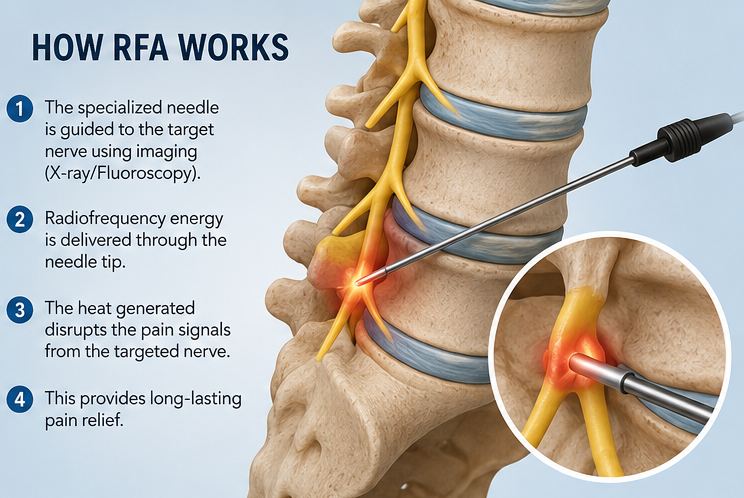
The radiofrequency energy produces heat at the tip of a specially designed needle. When accurately positioned near the targeted nerve, the energy can interrupt the nerve’s ability to transmit pain signals.
The goal is not to treat every nerve in the body or permanently eliminate all sensation. Instead, the procedure targets specific nerves believed to be contributing to a patient’s pain.
According to Cleveland Clinic, RFA uses radio waves to create a current that heats a small area of nerve tissue, reducing its ability to transmit pain signals to the brain. RFA is commonly used for selected chronic pain conditions, including pain involving the lower back, neck and arthritic joints.
Is RFA a Surgery?
RFA is generally considered a minimally invasive, non-surgical pain-management procedure.
It is performed using a thin needle rather than a large surgical incision. Depending on the treatment area, imaging such as X-ray or ultrasound may be used to accurately guide the needle to the target.
Good Life Pain Clinic describes several RFA procedures as outpatient/day-care interventions performed with imaging guidance and local anaesthesia.
How Does Radiofrequency Ablation Work?
Pain is transmitted through nerves from different parts of the body to the spinal cord and brain. When a particular nerve or nerve branch is responsible for carrying pain signals, targeting that nerve may reduce the transmission of those signals.
During RFA:
- The patient is positioned appropriately for the procedure.
- The treatment area is cleaned and prepared.
- Local anaesthesia is used to numb the skin and surrounding area.
- A specialised RFA needle is carefully guided toward the target nerve.
- Imaging guidance may be used to confirm the position of the needle.
- The specialist performs appropriate testing to help confirm the target.
- Controlled radiofrequency energy is delivered.
- The targeted nerve tissue is treated.
- The needle is removed and the patient is monitored.
The exact technique depends on the type and location of pain being treated.
Does RFA Destroy the Nerve?
RFA creates a controlled treatment area around the targeted nerve. In conventional thermal RFA, heat is used to create a lesion in the targeted nerve tissue.
However, the purpose is to reduce transmission of pain signals rather than to cause widespread nerve damage.
Different radiofrequency techniques may also be used for different clinical situations. For example, pulsed radiofrequency uses a different energy-delivery approach from conventional thermal RFA.
The appropriate technique should be selected by the treating pain specialist based on the patient’s diagnosis and treatment goals.
Who May Benefit From RFA Treatment?
RFA is not automatically recommended for everyone with chronic pain.
A pain specialist generally evaluates:
- The location and characteristics of the pain
- How long the pain has been present
- The suspected source of pain
- Previous treatments
- Response to medicines or injections
- Imaging and clinical findings where appropriate
- Medical history
- Other health conditions
- Whether diagnostic nerve blocks have identified a suitable pain generator
In some conditions, a diagnostic nerve block may be performed before RFA.
For example, Good Life Pain Clinic explains that medial branch blocks can be used to assess whether facet joints are contributing to back pain and whether radiofrequency treatment may be beneficial.
This is important because an abnormal MRI or X-ray does not necessarily mean that the abnormal structure is the actual source of someone’s pain.
Which Conditions Can Be Treated With RFA?
Radiofrequency procedures may be used for selected chronic pain conditions.
1. Chronic Back Pain
Certain patients with facet-joint-related back pain may be candidates for medial branch radiofrequency treatment.
Facet joints are small joints connecting the vertebrae of the spine. Degeneration, inflammation or injury affecting these joints can contribute to chronic back pain.
Good Life Pain Clinic describes facet joint injections and medial branch radiofrequency as part of its interventional approach to selected back pain conditions.
2. Knee Pain
RFA may also be considered for selected patients with chronic knee pain.
One commonly discussed approach is genicular nerve radiofrequency ablation. Genicular nerves carry pain signals from areas around the knee.
Good Life Pain Clinic offers genicular nerve blocks and radiofrequency ablation for selected chronic knee pain, including pain associated with osteoarthritis and persistent pain following knee replacement.
3. Neck Pain
In carefully selected patients, radiofrequency procedures may be used to treat pain associated with certain cervical facet joints.
The specific nerves targeted depend on the suspected pain generator and the patient’s clinical assessment.
4. Nerve-Related Pain
Certain radiofrequency techniques may be used for selected nerve-related pain conditions.
Good Life Pain Clinic also describes lumbar dorsal root ganglion pulsed radiofrequency as an intervention that may help extend the duration of relief from injections in selected patients with radiating pain.
5. Shoulder and Other Pain Conditions
Radiofrequency procedures can sometimes be considered for other pain conditions depending on the nerve responsible for transmitting pain.
For example, Good Life Pain Clinic lists suprascapular nerve radiofrequency for selected shoulder pain and other radiofrequency procedures in its cancer-pain management services.
The suitability of RFA depends on the individual diagnosis rather than simply the body part that hurts.
What Happens Before RFA Treatment?
A detailed consultation is an important part of the RFA process.
Your pain specialist may ask about:
- Your symptoms
- Pain duration
- Pain intensity
- Activities that increase or decrease pain
- Previous treatments
- Medicines
- Previous injections
- Medical conditions
- Previous surgeries
- Imaging or investigation reports
Depending on the condition, your doctor may recommend diagnostic injections or nerve blocks before proceeding with RFA.
This helps determine whether the suspected nerve is actually contributing significantly to the pain.
Why Is a Diagnostic Nerve Block Sometimes Used?
A diagnostic nerve block temporarily numbs a specific nerve or group of nerves.
If the patient’s typical pain improves significantly after the block, it may provide useful information about the source of pain and whether RFA could be appropriate.
However, the decision to perform RFA should be based on the complete clinical assessment rather than on one test alone.
Radiofrequency Ablation Procedure: Step-by-Step
The exact procedure varies according to the target nerve and condition, but the general process involves several steps.
Step 1: Patient Assessment
Before treatment, the pain specialist reviews the diagnosis, symptoms, investigations and previous treatment response.
Step 2: Positioning
The patient is positioned so that the treatment area can be accessed safely.
Step 3: Skin Preparation
The skin is cleaned carefully to reduce the risk of infection.
Step 4: Local Anaesthesia
Local anaesthetic is generally used to numb the area around the needle entry point.
Good Life Pain Clinic notes that its interventional procedures are generally performed under local anaesthesia, with general anaesthesia or sedation not usually required.
Step 5: Needle Placement
A specialised needle is carefully advanced toward the target nerve.
Imaging guidance such as X-ray or ultrasound may be used depending on the procedure.
Step 6: Target Confirmation
The specialist may perform appropriate sensory or motor testing before delivering radiofrequency energy.
Step 7: Radiofrequency Energy
Controlled radiofrequency energy is delivered to the target area.
The objective is to reduce the nerve’s ability to transmit pain signals.
Step 8: Monitoring
After the procedure, the patient is monitored for a period before being discharged when appropriate.
Good Life Pain Clinic states that its interventional procedures generally take approximately 30–60 minutes, followed by a period of observation.
How Long Does RFA Treatment Take?
The actual procedure time depends on:
- The treatment location
- Number of nerves being treated
- Type of RFA
- Patient anatomy
- Whether multiple areas are being treated
- The clinical complexity of the case
Good Life Pain Clinic states that its interventional pain procedures generally take around 30–60 minutes, with approximately 2–4 hours of post-procedure observation.
Your doctor will provide more specific instructions based on the procedure planned for you.
Radiofrequency Ablation Treatment Cost in India
One of the most common questions patients ask is:
“How much does Radiofrequency Ablation cost in India?”
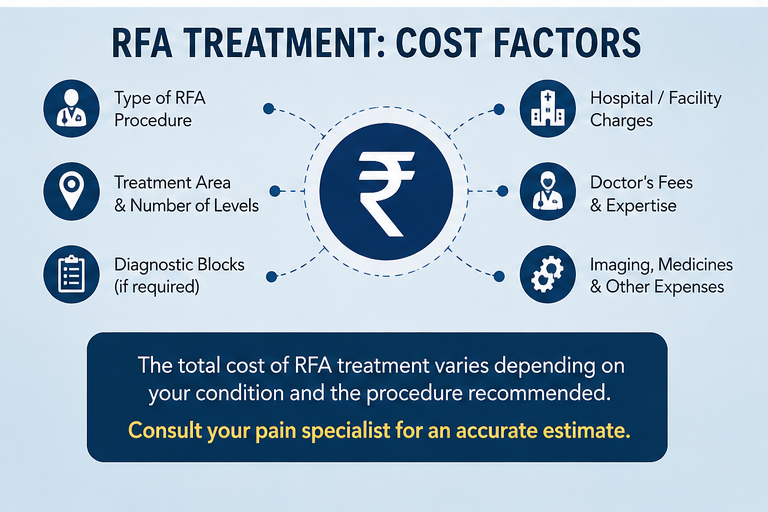
There is no single fixed price because RFA can be performed for different conditions and at different anatomical locations.
The total cost may depend on:
- Type of RFA
- Treatment area
- Number of nerves being treated
- Number of levels treated
- Diagnostic blocks required beforehand
- Imaging guidance
- Hospital or procedure-room charges
- Doctor’s professional fees
- Medicines and consumables
- Follow-up requirements
Published online estimates also vary considerably because different procedures are grouped under the term “RFA.” For example, Practo’s current India listings show different price ranges by city and procedure type, illustrating why an online average should not be treated as an individual patient’s quotation.
What Is the Cost of RFA in Vadodara?
The Radiofrequency Ablation treatment cost in Vadodara depends on the condition being treated and the exact procedure recommended.
For example, the cost of genicular RFA for knee pain may differ from medial branch RFA for back pain or pulsed radiofrequency treatment for a nerve-related condition.
Therefore, rather than quoting one generic RFA price, patients should have their condition assessed and ask for a procedure-specific estimate.
At Good Life Pain Clinic, the appropriate treatment and expected costs can be discussed during consultation based on the patient’s diagnosis and planned intervention.
Is RFA Covered by Health Insurance?
Insurance coverage for RFA depends on:
- Your insurance policy
- The medical indication
- Whether the procedure is considered covered under the policy
- Pre-authorisation requirements
- Network/provider arrangements
- Insurer-specific rules
Patients should contact their insurance provider before treatment to understand eligibility, documentation and reimbursement requirements.
Do not assume that every RFA procedure will automatically be covered simply because it is medically recommended.
What Is RFA Recovery Like?
One of the potential advantages of RFA is that it generally does not require the prolonged recovery associated with major surgery.
However, recovery differs between patients and depends on the procedure.
Some patients may experience:
- Mild soreness
- Temporary increase in pain
- Bruising or tenderness around the needle site
- Temporary numbness
- Local discomfort
Cleveland Clinic notes that pain or burning at the treatment site can occur and may persist for a week or two in some patients. It also reports that many people can return to regular activities after a short period of rest.
When Does Pain Relief Start After RFA?
Pain relief is not necessarily immediate.
Some patients may notice improvement relatively soon, while others may take several days or longer to experience the full effect.
The expected timeline depends on:
- The nerve treated
- Type of RFA
- Underlying condition
- Individual healing response
- Whether temporary post-procedure soreness occurs
Your pain specialist can explain what to expect from your particular procedure.
RFA Aftercare: What Should You Do?
Your doctor will provide individual aftercare instructions, but common recommendations may include:
- Rest for the recommended period
- Keep the treatment area clean
- Avoid strenuous activities initially
- Follow medication instructions
- Gradually return to normal activities
- Follow rehabilitation or physiotherapy recommendations where appropriate
- Attend follow-up appointments
Contact your healthcare provider if you develop concerning symptoms such as increasing redness, significant swelling, fever, severe or worsening pain, new weakness or other unexpected symptoms.
How Long Does RFA Pain Relief Last?
The duration of pain relief varies significantly between patients.
RFA does not necessarily provide permanent relief because nerves can recover over time.
The duration may depend on:
- The underlying condition
- Nerve treated
- Type of RFA
- Individual healing
- Activity levels
- Overall treatment plan
Some patients may experience relief for months or longer, while others may experience a shorter duration.
Because the underlying pain condition can vary considerably, your doctor should discuss the expected outcome for your specific case rather than promising a fixed duration.
Benefits of Radiofrequency Ablation
For appropriately selected patients, potential benefits of RFA may include:

Minimally Invasive Treatment
RFA uses specialised needles rather than a large surgical incision.
Potential Longer-Lasting Pain Relief
Some patients experience longer-lasting relief compared with temporary injections.
Short Recovery
Many patients can return to normal activities relatively quickly, depending on the procedure.
May Reduce Dependence on Pain Medicines
When pain is successfully controlled, some patients may be able to reduce their reliance on certain pain medicines under medical supervision.
May Delay or Avoid Certain Surgical Procedures
For selected conditions, RFA can provide a non-surgical treatment option when appropriate.
However, RFA should not be presented as a replacement for surgery in every patient. The best treatment depends on the cause and severity of the condition.
Risks and Side Effects of RFA
Although RFA is generally considered minimally invasive, no medical procedure is completely risk-free.
Possible side effects may include:
- Temporary pain at the treatment site
- Burning sensation
- Bruising
- Temporary numbness
- Infection
- Bleeding
- Temporary worsening of pain
- Nerve irritation or injury
Serious complications are uncommon, but they can occur.
Cleveland Clinic notes that complications such as infection and bleeding at the needle site are uncommon, while rare complications can include persistent pain or nerve damage.
Your doctor should discuss the potential benefits and risks with you before the procedure.
RFA vs Surgery: Which Is Better?
There is no universal answer.
RFA and surgery are different treatments intended for different clinical situations.
RFA may be considered when:
- The pain has a specific nerve-related source
- Conservative treatments have not provided adequate relief
- Diagnostic testing supports the suspected pain generator
- The patient is an appropriate candidate
Surgery may be required when there is a structural problem that needs surgical correction or when conservative and interventional treatments are inappropriate or unsuccessful.
The correct approach is to identify the cause of pain first and then choose the most appropriate treatment.
RFA vs Nerve Block: What’s the Difference?
A nerve block typically involves injecting medication around a nerve to temporarily reduce pain and/or provide diagnostic information.
RFA uses radiofrequency energy to create a controlled treatment effect on the targeted nerve.
A nerve block may sometimes be performed as a diagnostic step before RFA.
For example, Good Life Pain Clinic describes medial branch blocks as diagnostic tests that can help assess whether facet joint pain may respond to radiofrequency treatment.
Is RFA Painful?
The procedure is generally performed after the treatment area has been numbed with local anaesthesia.
Patients may still experience pressure, brief discomfort or sensations during parts of the procedure.
After RFA, temporary soreness or burning around the treatment site can occur.
If you are anxious about the procedure, discuss your concerns with your pain specialist before treatment.
Can RFA Be Used for Knee Pain?
Yes, selected patients with chronic knee pain may be candidates for genicular nerve radiofrequency ablation.
This may be considered in situations such as:
- Chronic osteoarthritis-related knee pain
- Persistent pain after knee replacement
- Patients who are not suitable for surgery
- Patients who do not want surgery
- Persistent pain despite other treatments
Good Life Pain Clinic specifically describes genicular nerve blocks and RFA for selected chronic knee pain and also offers cooled radiofrequency treatment.
A proper assessment is necessary before deciding whether RFA is suitable.
Can RFA Be Used for Back Pain?
Yes. Radiofrequency procedures may be used for selected patients whose chronic back pain is associated with facet joints.
Medial branch radiofrequency targets nerves that carry pain signals from the facet joints.
Good Life Pain Clinic describes medial branch blocks as a diagnostic approach and medial branch radiofrequency as an interventional treatment for selected facet-joint-related back pain.
However, not all back pain originates from facet joints. Disc problems, nerve compression, muscle-related pain and other conditions require different assessments and treatments.
Who Should Perform RFA?
Because RFA involves precise targeting of nerves and requires appropriate patient selection, it should be performed by a suitably trained medical professional with expertise in interventional pain management.
At Good Life Pain Clinic, Dr. Akanksha Bansal is listed as an MD, FIAPM gold medallist and European Diploma in Pain Medicine holder, with a focus on pain and palliative care. The clinic describes her experience in interventional pain approaches and chronic pain management.
Patients should always discuss their individual diagnosis, treatment alternatives, expected benefits and potential risks with their treating specialist.
Why Choose Good Life Pain Clinic for RFA Treatment?
Good Life Pain Clinic focuses on pain and palliative care, with treatment options for several chronic pain conditions including knee pain, back pain, sciatica, shoulder pain, joint pain and cancer-related pain.
The clinic’s website describes an individualized treatment approach rather than using one treatment for every patient. Its interventional pain services include radiofrequency procedures, nerve blocks and other minimally invasive options.
The clinic is located in Vasna Road, Vadodara, Gujarat, making it accessible to patients seeking specialized pain-management services in Vadodara.
If you have persistent pain despite medicines, physiotherapy or other treatments, a consultation with a pain specialist can help determine the source of your pain and whether an intervention such as RFA may be appropriate.
Frequently Asked Questions About RFA Treatment
1. What is Radiofrequency Ablation used for?
RFA is used to reduce pain by targeting selected nerves responsible for transmitting pain signals. It may be used for certain chronic back, neck, knee, joint and nerve-related pain conditions.
2. How long does Radiofrequency Ablation take?
The procedure itself commonly takes around 30–60 minutes, although the total time at the facility can be longer because of preparation and post-procedure observation. Good Life Pain Clinic states that its interventional procedures generally take 30–60 minutes.
3. Is RFA a permanent treatment?
No. RFA does not guarantee permanent pain relief. Nerves can recover over time, and the duration of relief varies between patients.
4. How much does RFA treatment cost in India?
The cost varies according to the type of RFA, treatment area, number of nerves or levels treated, imaging guidance, facility charges and other factors. A personalized estimate is more meaningful than a generic online price.
5. What is the RFA treatment cost in Vadodara?
The cost depends on the specific RFA procedure recommended for your condition. Patients should consult the clinic for a procedure-specific estimate after clinical evaluation.
6. Is RFA painful?
Local anaesthesia is generally used to reduce discomfort during the procedure. Some patients may experience temporary soreness or burning after treatment.
7. How long does it take to recover from RFA?
Recovery is generally shorter than recovery from major surgery, but it varies according to the procedure and patient. Some patients return to normal activities quickly, while others may require additional rest.
8. Can RFA treat knee pain?
Yes. Genicular nerve RFA can be considered for selected patients with chronic knee pain, including certain cases of osteoarthritis-related pain and persistent pain after knee replacement.
9. Can RFA treat back pain?
Yes, selected patients with facet-joint-related back pain may benefit from medial branch radiofrequency treatment.
10. Is RFA better than surgery?
Not necessarily. RFA and surgery treat different problems. The appropriate treatment depends on the cause of pain, severity, previous treatments and the patient’s overall condition.
11. Do I need a nerve block before RFA?
In some situations, a diagnostic nerve block may be recommended before RFA to determine whether the suspected nerve is contributing to the pain.
12. Can everyone with chronic pain have RFA?
No. RFA is not appropriate for every type of pain. A pain specialist should evaluate the cause of pain and determine whether the procedure is suitable.
When Should You Consult a Pain Specialist?
Consider consulting a pain specialist if your pain:
- Has continued for several weeks or months
- Interferes with sleep
- Limits walking or daily activities
- Has not improved adequately with conservative treatment
- Continues despite appropriate medication
- Returns repeatedly after temporary treatment
- Is affecting your work or quality of life
Early and accurate assessment can help identify the underlying source of pain and determine which treatment options are appropriate.
Book a Consultation for RFA Treatment in Vadodara
If chronic pain is affecting your daily life, you do not have to assume that surgery is the only option.
Radiofrequency Ablation may be an option for selected patients with specific types of chronic pain. The first step is to understand the cause of your pain and determine whether RFA is medically appropriate for you.
At Good Life Pain Clinic, Vadodara, pain-management treatment is tailored to the patient’s condition and may include minimally invasive procedures such as radiofrequency treatments, nerve blocks and other interventional approaches.
Book a consultation with Dr. Akanksha Bansal to discuss your chronic pain, treatment options and whether RFA may be suitable for your condition.
Good Life Pain Clinic
First Floor, Trinity Complex, Opp. Caffeine Restaurant, Vasna Jakat Naka, Vasna Road, Vadodara, Gujarat – 390015
Phone: +91-9484540774
Email: goodlifepainclinic@gmail.com